Evenings are short and tired; generic activity apps add pressure instead of relief.
02 · The signal
Behavioral interviews showed fatigue and attention — not willingness — were the real barriers.
03 · The response
Designed one small daily ritual, supported by age-tiered physical cards and gentle digital prompts.
04 · The impact
Connection became a repeatable habit families could keep on their worst evenings, not just their best.
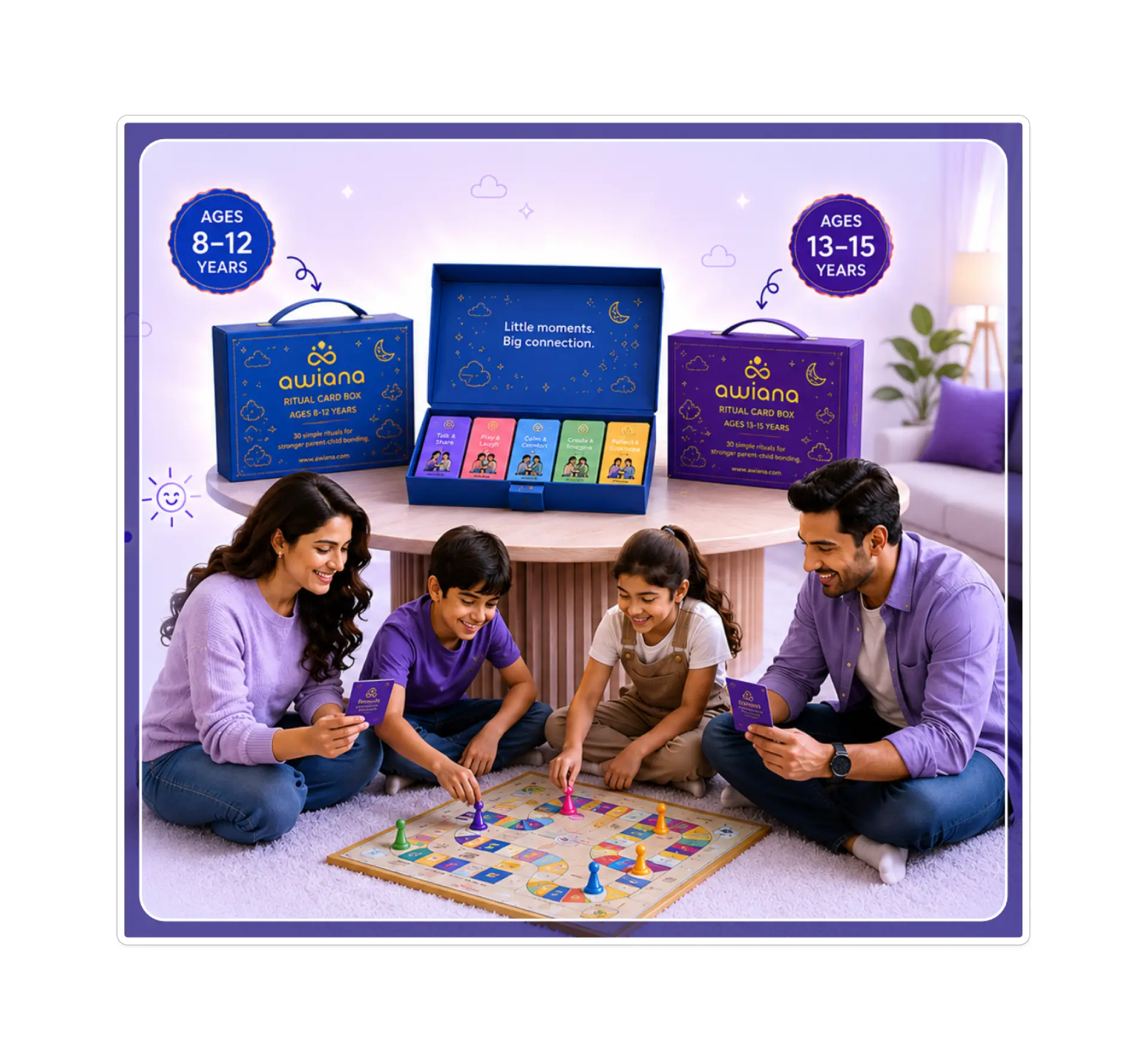
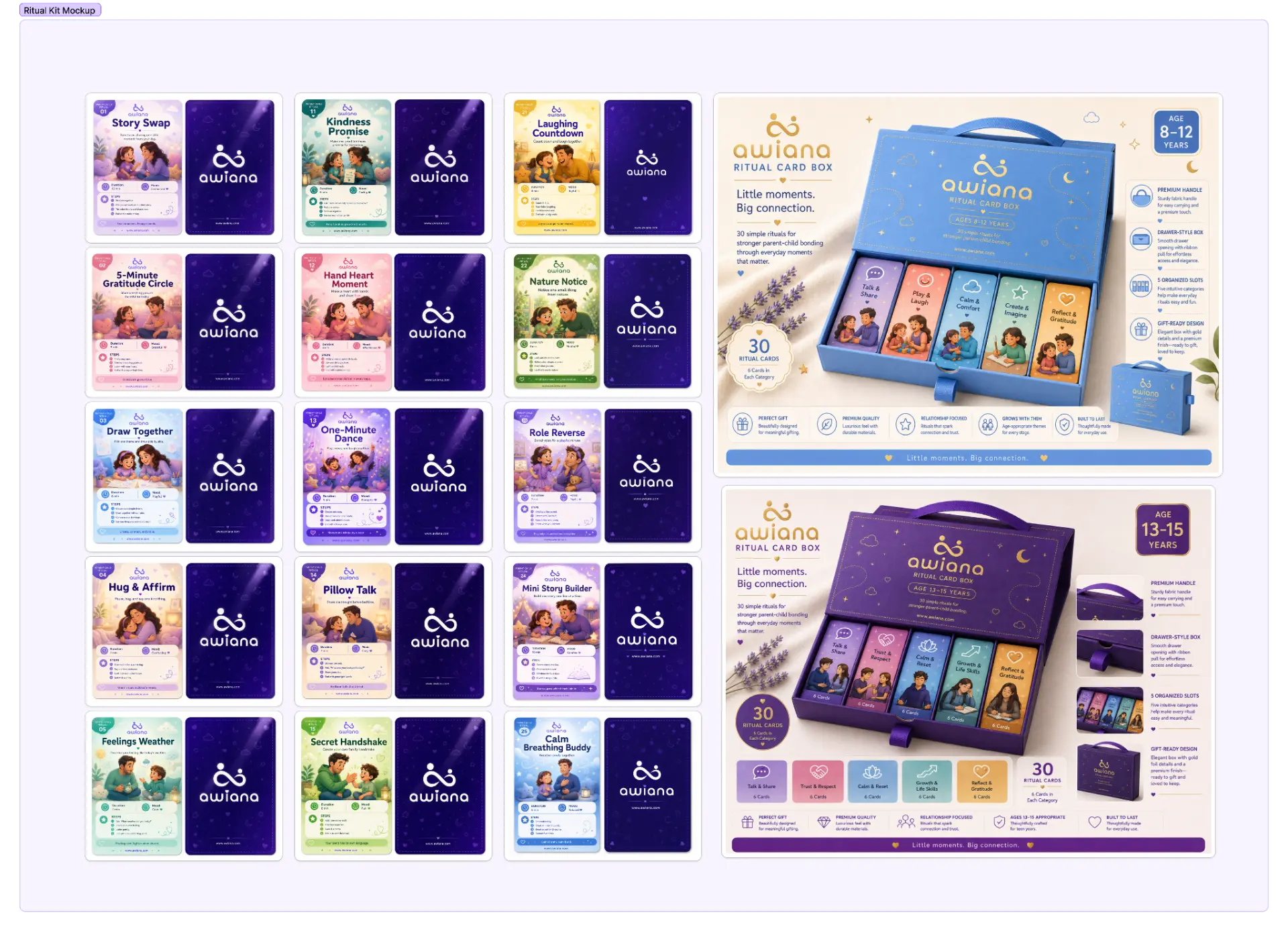
Product concept — age-tiered ritual card boxes designed for family play.
00Overview
Designing an intervention, not an app
AWIANA helps working parents turn limited evening time into emotionally rich moments with their children. It is built on the reality of tired parents and short attention windows.
The product designs for connection, not screen time — a physical ritual card kit paired with a companion app, using small repeatable rituals that fit real family rhythms.
01Context
The behavior we were trying to change
The target behavior was simple to describe and hard to sustain: one warm, shared moment between parent and child, every day. Everything else in the product exists to make that behavior cheaper to perform.
Evenings are short, tired, and easily interrupted
Children need consistency and presence, not novelty
Most tools optimise for engagement, not emotional warmth
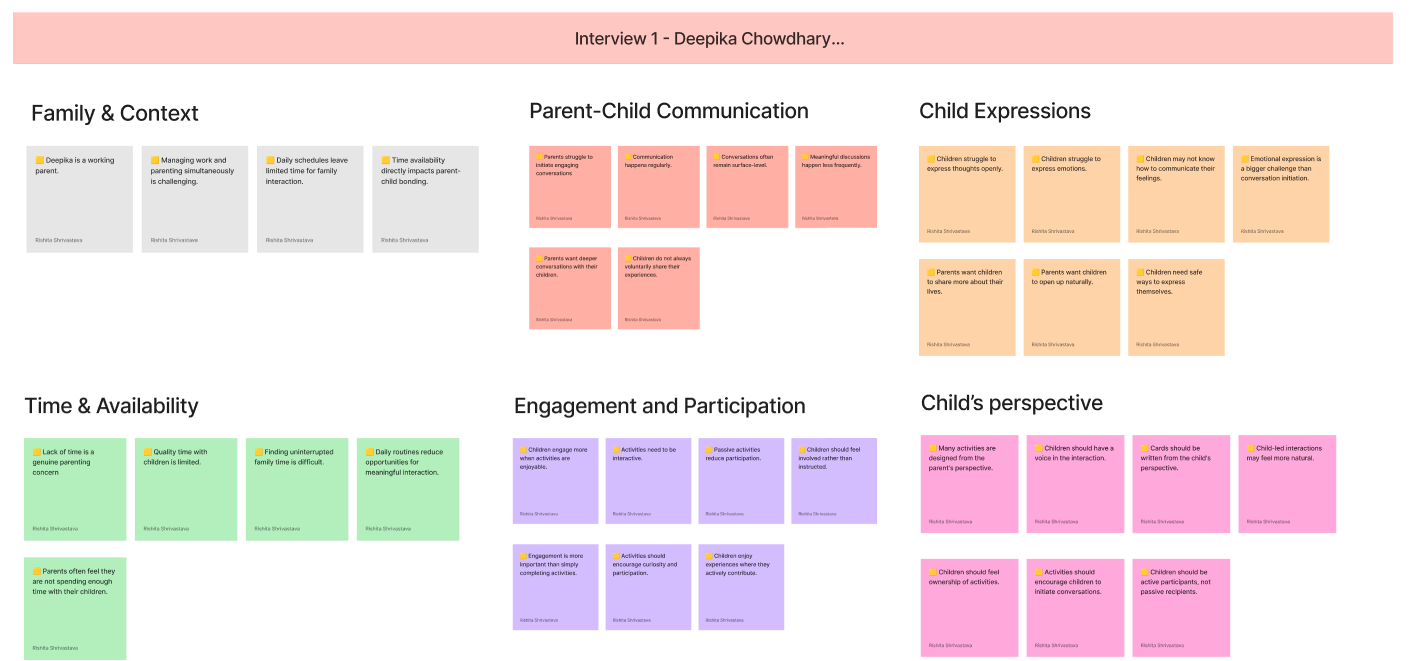
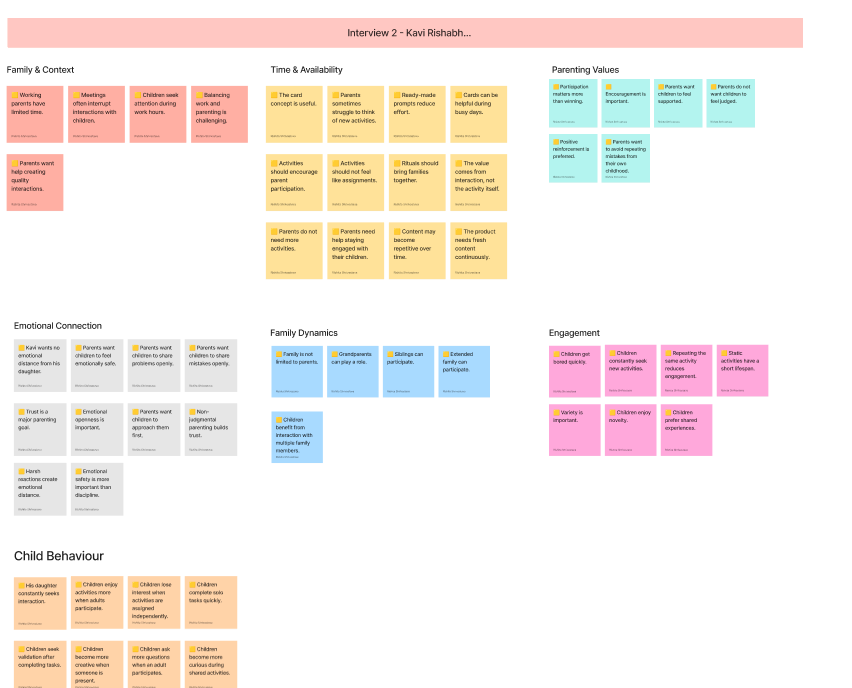
Research artifact
02Tension
The motivation was there; the energy wasn't
Parents did not need convincing that connection matters. They needed the moment to cost almost nothing. Guilt about 'not doing enough' was the emotional barrier standing between intention and action — and activity apps that suggested elaborate plans made it worse.
Survey evidence
75%
of parents scored 3 or above on mental exhaustion after work (survey, n=68)
Feeling mentally tired#1 barrier27.9%
Lack of time23.5%
Lack of energy14.7%
Child prefers screens13.2%
Don't know what to do10.3%
The top three barriers — mental tiredness, lack of time, and lack of energy — account for 66% of all responses. This is what shifted the project from a scheduling problem to a decision-fatigue problem.
03Insight
What behavioral research revealed
Behavioral interviews with working parents surfaced the emotional triggers, existing rituals, and friction points that shape evening connection — and where those rituals reliably break down.
Fatigue and attention are the real design constraints
The trust gap
85.3%
open to ready-made activity ideas
5.9%
have ever used a parenting app
39.7%
report low trust in ready-made solutions
Insight map
60+ observations from parent and child interviews, clustered into 6 recurring behavioral themes: Limited Quality Time, Child Agency, Curiosity & Play, Emotional Expression, Screen-Time Concerns, Content Fatigue.
04Direction
From motivation to ritual
AWIANA frames bonding as a ritual rather than a task. The experience lowers the barrier to connection — one small, warm action a day — and reinforces it with emotionally intelligent feedback rather than streak pressure.
What I saw
Parents abandoned activity apps after a few days, describing them as 'one more thing to do'.
What it meant
Every additional choice was a cost paid at the exact moment parents had least energy.
What I changed
Reduced the product to a single daily ritual, chosen for them.
Why
Removing decision fatigue makes the desired behavior the easiest available option.
What happened
The ritual became performable on low-energy evenings, which is when it matters most.
What I saw
Streaks and progress pressure produced guilt, then avoidance, when a day was missed.
What it meant
Reinforcement had to reward presence, not perfection.
What I changed
Replaced streak mechanics with gentle prompts and warm, human language.
Why
A ritual that forgives interruption survives real family life; one that punishes it does not.
What happened
Feedback loops encouraged return after a missed day instead of ending the habit.
05Making
The ritual loop, physical and digital
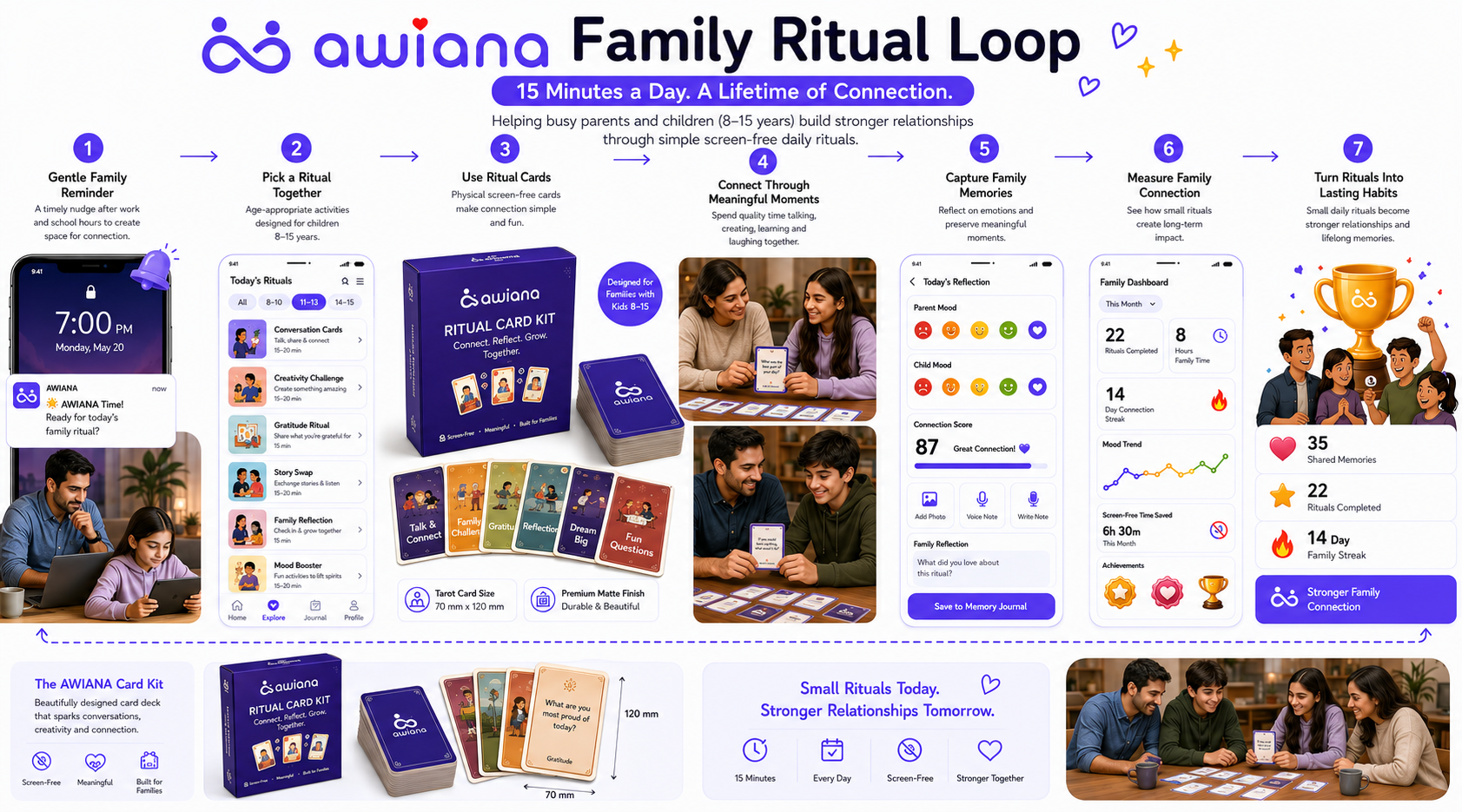
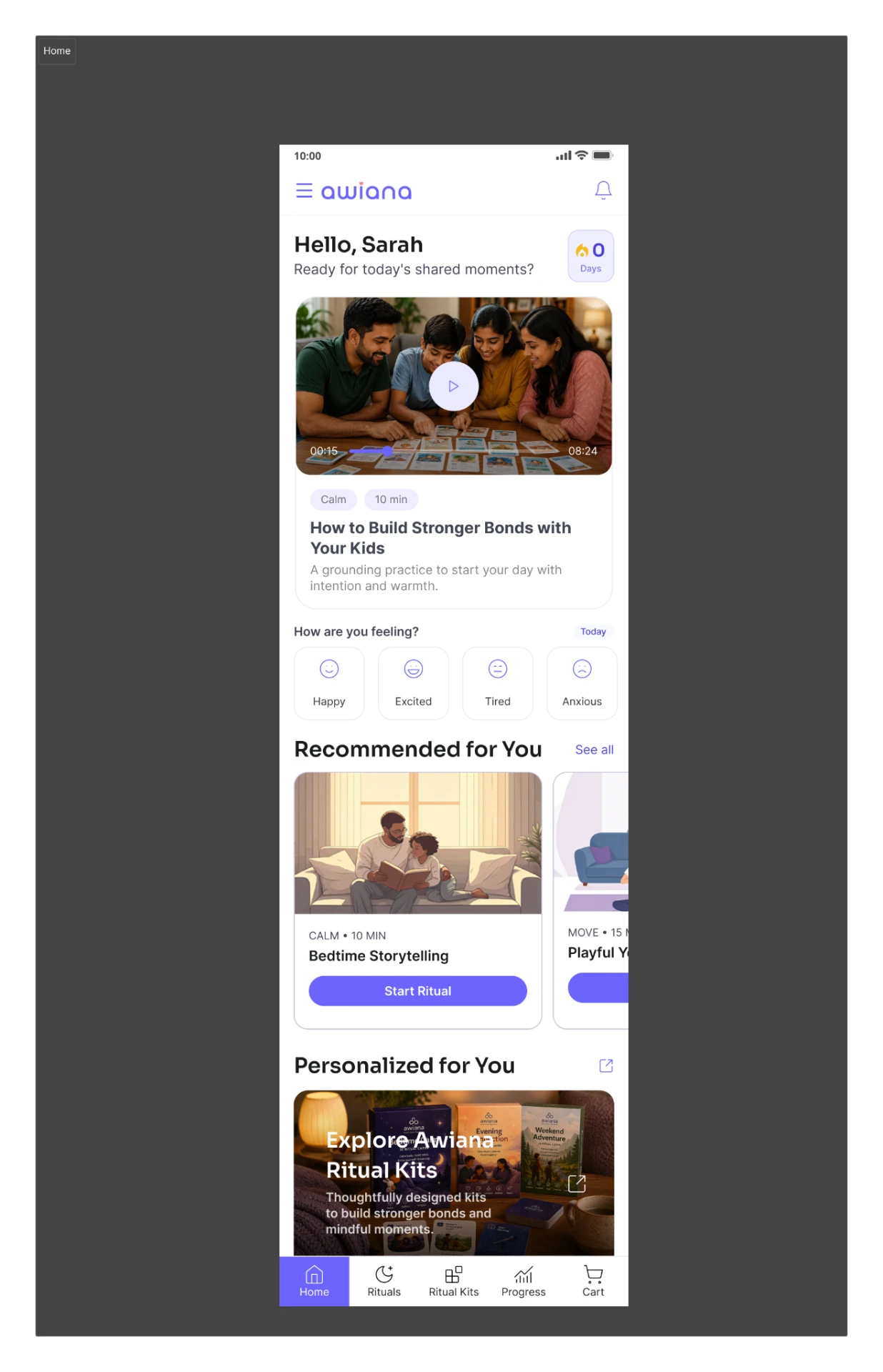
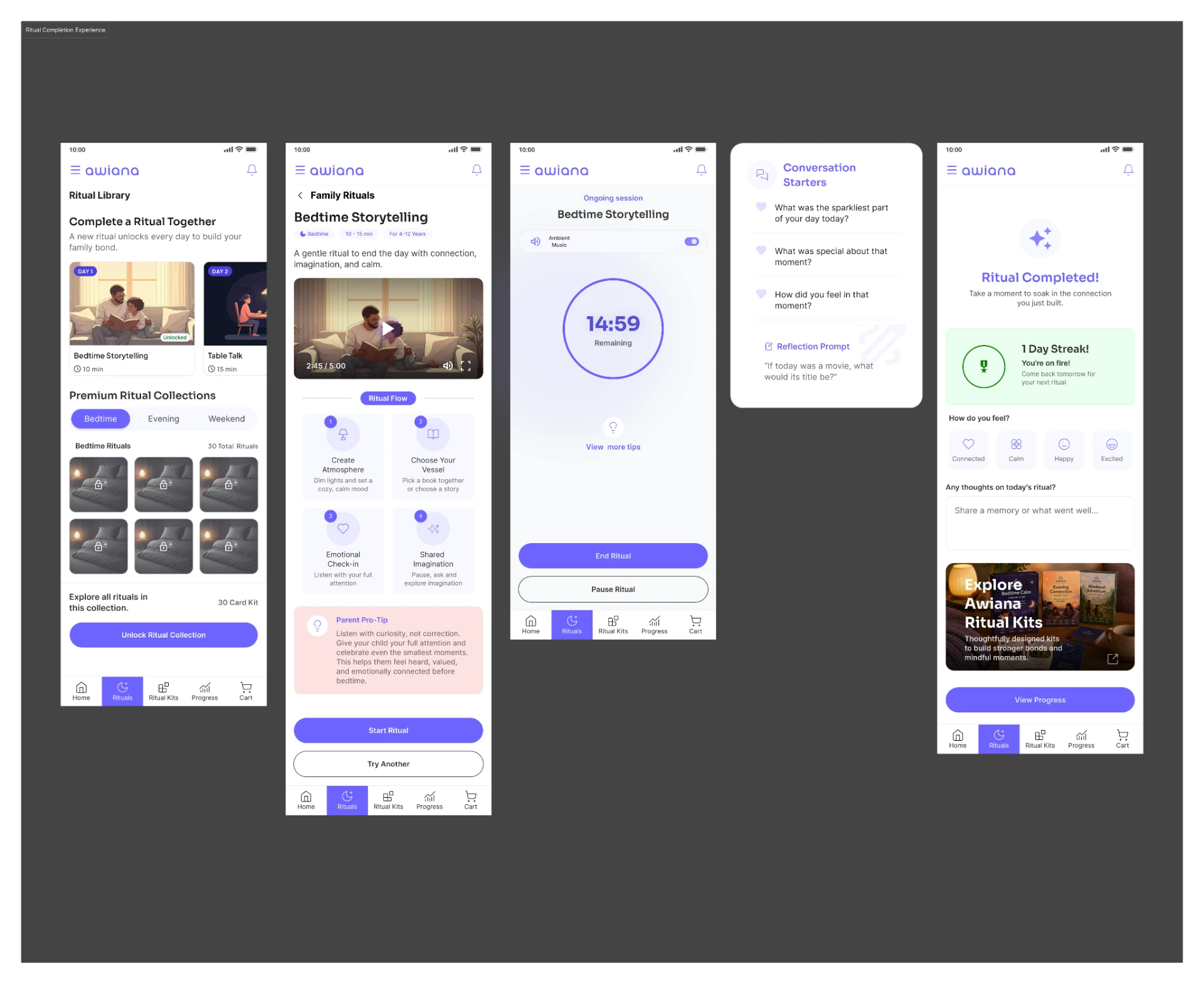
The experience runs as a loop: a gentle evening reminder, a shared ritual drawn from the age-tiered card set, and a short reflective moment. Digital and physical touchpoints each do the part they are best at.
Final experienceThe complete daily ritual loop — from gentle reminder to lasting habit.
Design exploration
The ritual loop, from evening prompt to reflection.
Physical product30 illustrated ritual cards across five categories, packaged in age-tiered kits for 8–12 and 13–15 year olds.
06Proof
Testing against fatigue, not enthusiasm
Ritual concepts were checked against the emotional and energy constraints from research — favouring warmth and consistency over feature depth. The experience was repeatedly simplified, removing pressure and complexity so a single warm moment could still happen on a low-energy evening.
Validation
What testing showed
Two flows were usability-tested — starting and completing a ritual, and purchasing a ritual kit. The synthesis pointed at structure, not motivation.
Parents need structure more than time — the gap was a framework for engagement, not intent
Children are motivated by fun, not bonding — emotional connection should be the outcome, not the pitch
Children engaged more when given choice and agency over activities
Repetition caused fatigue — variety and progressive difficulty mattered for retention
07Impact
What changed
15–20 min
Sustainable daily ritual
2
Age-tiered card sets
Physical + digital
Connected ecosystem
What changed
Bonding stopped being an ambitious plan and became a small, repeatable ritual. The physical cards carry the moment, the app protects it — and the bar for a good evening drops low enough that families can actually clear it.
What I learned
The barrier was emotional, not functional: parents needed permission to keep it small.
A physical artifact does behavioral work a screen cannot — the cards sit on the table and start the moment.
Designing for the low-energy default, rather than the motivated ideal, is what makes a ritual survive.
What I would do next
Run a two-week diary study with families to observe real ritual adherence.
Test age-tier differences between the 8–12 and 13–15 card sets.
Next project
VOUCH
Making invisible care work visible, portable and trusted