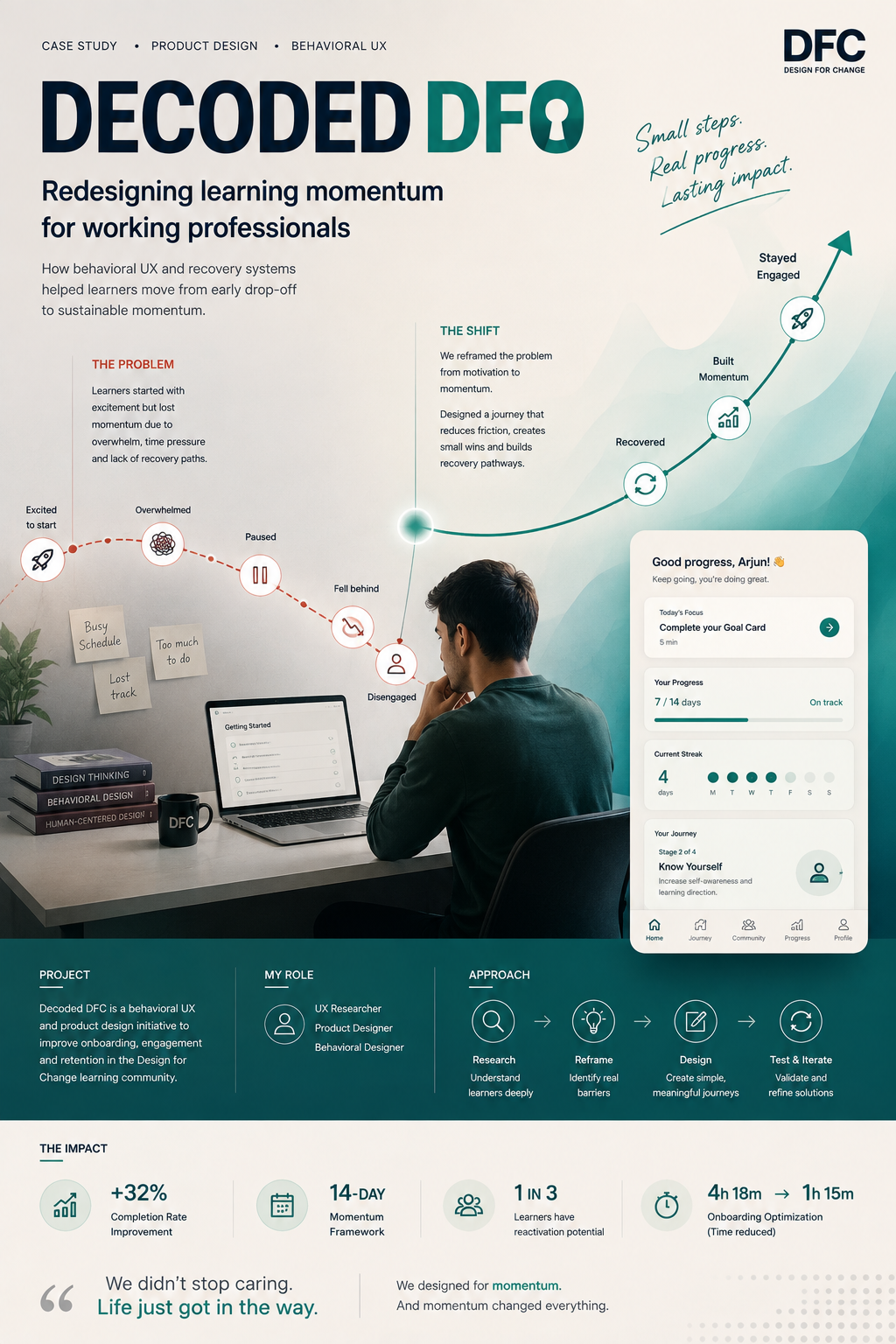
Case study overview — problem, reframe, redesigned experience and impact. Open full size.Conceptual framework — the shape of the retention problem: a fragmented early journey with repeated friction, a structural reframe, and a continuous path built from small, sequential wins.
Quick read
Problem
Learners were disengaging during the early journey.
“We didn't stop caring. Life just got in the way.”
Learners joined Design for Change with excitement and strong intent to grow. However, many disappeared during onboarding.
At first glance, inactivity looked like a motivation problem.
Research revealed something different. Most learners still wanted to continue.
The real problem was not motivation.
The real problem was momentum.
01 · Context
The project, and what I owned inside it
The project
Decoded DFC is a behavioral UX and Product Design initiative focused on improving learner onboarding, engagement, and retention within the Design for Change community.
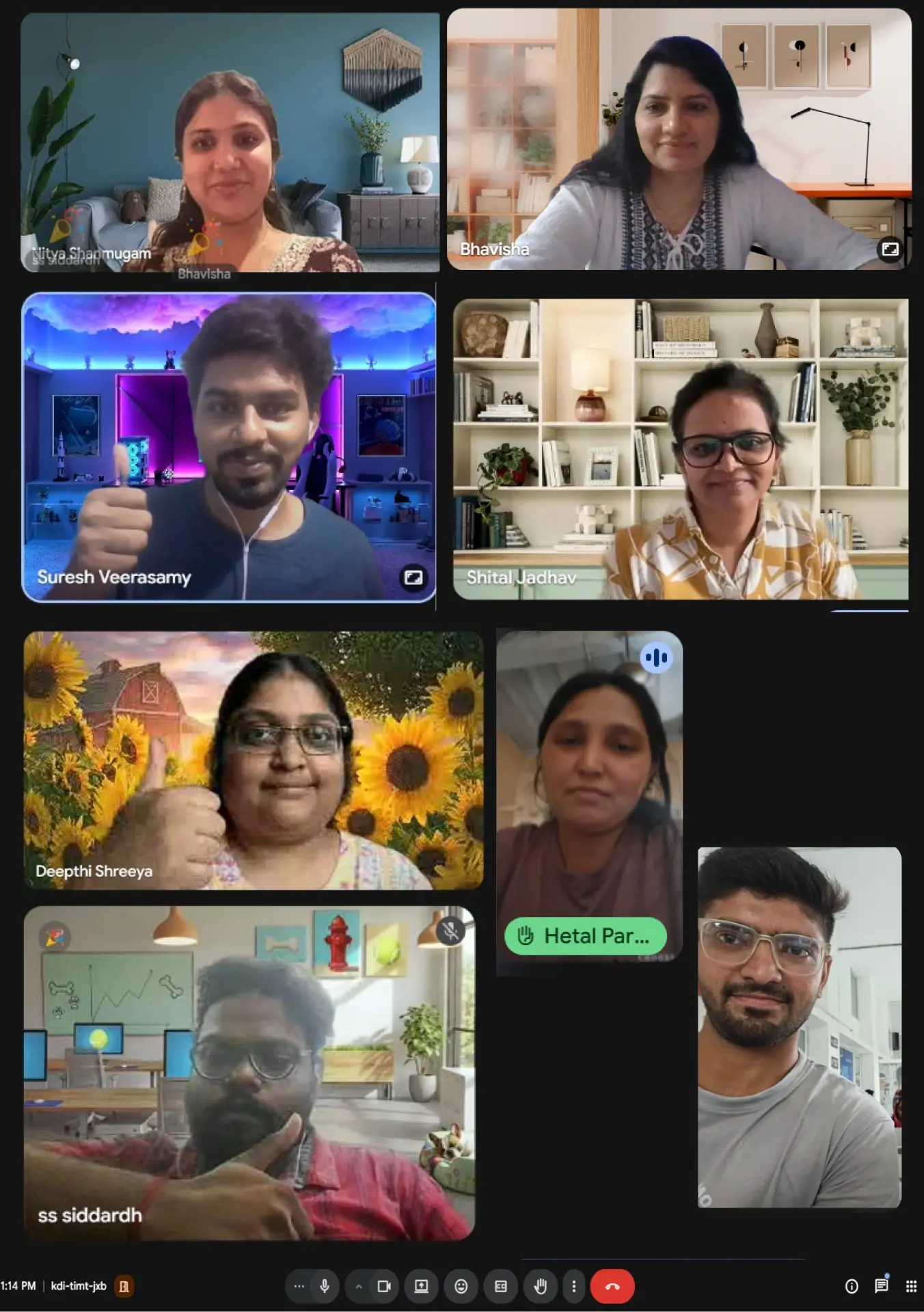
Delivered with a team of 8 designers and researchers.
A distributed working session with the DFC design and research team.
My contribution
UX Research
Research synthesis
Learner behavior analysis
Retention gap identification
Product Design
Onboarding strategy
Learner journeys
Information architecture
Interaction flows
Behavioral Design
Habit formation principles
Recovery systems
Cognitive load reduction
Momentum-building mechanisms
02 · Problem
Where the journey broke
Join
High intent, no clear first action
Explore
Full catalogue surfaced at once
Start
Long onboarding content before any win
Get Overwhelmed
Videos, templates, uploads, expectations
Pause
A single busy evening breaks the streak
Fall Behind
Backlog anxiety, no way back in
Disengage
Lifetime access becomes indefinite deferral
How might we
How might we help learners maintain momentum, consistency, and emotional connection with DFC during low-energy, high-pressure, and time-constrained phases of life?
03 · Research
Research at scale
235+
Learner touchpoints
162
Survey participants
115
Telephonic outreach
73
Behavioral audit records
12
Learner interviews
71%
Call response rate
Method sequence
Community Survey
Telephonic Outreach
Behavioral Audit
Interviews
Community Conversations
Platform Analytics
Behavioral audit funnel
Every additional onboarding step increased drop-off.
73Total learners
100%
41Responded
56%
14Started any Getting Started activity
19%
12Completed Goal Card
16%
5Completed Vision Board
7%
5Completed Values Exercise
7%
3Completed Personality Assessment
4%
0Completed full journey
0%
04 · Insights
What the evidence actually said
01
Inactive does not mean lost
Evidence
Many inactive learners still expressed interest in continuing when contacted directly.
Interpretation
Disengagement was a pause, not a decision to quit.
Design implication
Design re-entry points instead of treating inactivity as churn.
02
The first week was the highest-risk period
Evidence
Early drop-off happened before learners experienced meaningful success.
Interpretation
Learners left before the product had a chance to prove its value.
Design implication
Move the first meaningful win as early as possible in the journey.
03
Cognitive overload reduced participation
Evidence
Learners encountered long onboarding content, multiple videos, templates, Codex activities, upload requirements and community expectations.
Interpretation
More content was not producing more progress — it was producing hesitation.
Design implication
Reduce visible surface area and reveal depth progressively.
04
Time pressure was the largest barrier
Evidence
Work commitments, family responsibilities, health concerns and job search activities.
Interpretation
The constraint was availability, not intent.
Design implication
Pace the journey to real availability, not ideal availability.
05
Recovery paths were missing
Evidence
Missed activities created backlog anxiety → loss of confidence → disengagement.
Interpretation
One missed day compounded into a permanent exit.
Design implication
Build explicit recovery mechanisms so falling behind is reversible.
Evidence → insight → decision
Evidence
Learners were overwhelmed by the number of onboarding requirements.
Insight
More content was not increasing progress.
Design decision
Reduce cognitive load and create smaller, sequential actions.
Expected behavior
Learners can complete one meaningful action without feeling behind.
Evidence
Drop-offs concentrated at day 3–4 of a 7-day onboarding; interviews described guilt after one missed day.
Insight
The learning rhythm ignored working professionals' time and energy constraints.
Design decision
Extend the momentum challenge from 7 days to 14.
Expected behavior
A missed evening stops being a reason to quit.
Evidence
Learners froze at sign-up with the full catalogue in front of them.
Insight
Choice overload, not content quality, was blocking the first session.
Design decision
Replace the flat content dump with four structured stages and progressive disclosure.
Expected behavior
Every learner sees one clear next action and legible progress.
The reframe
The retention problem was not motivational. The retention problem was structural.
Instead of asking
“How do we deliver more content?”
We asked
“How do we help learners complete one meaningful action every day?”
06 · Opportunities
Four strategic opportunities
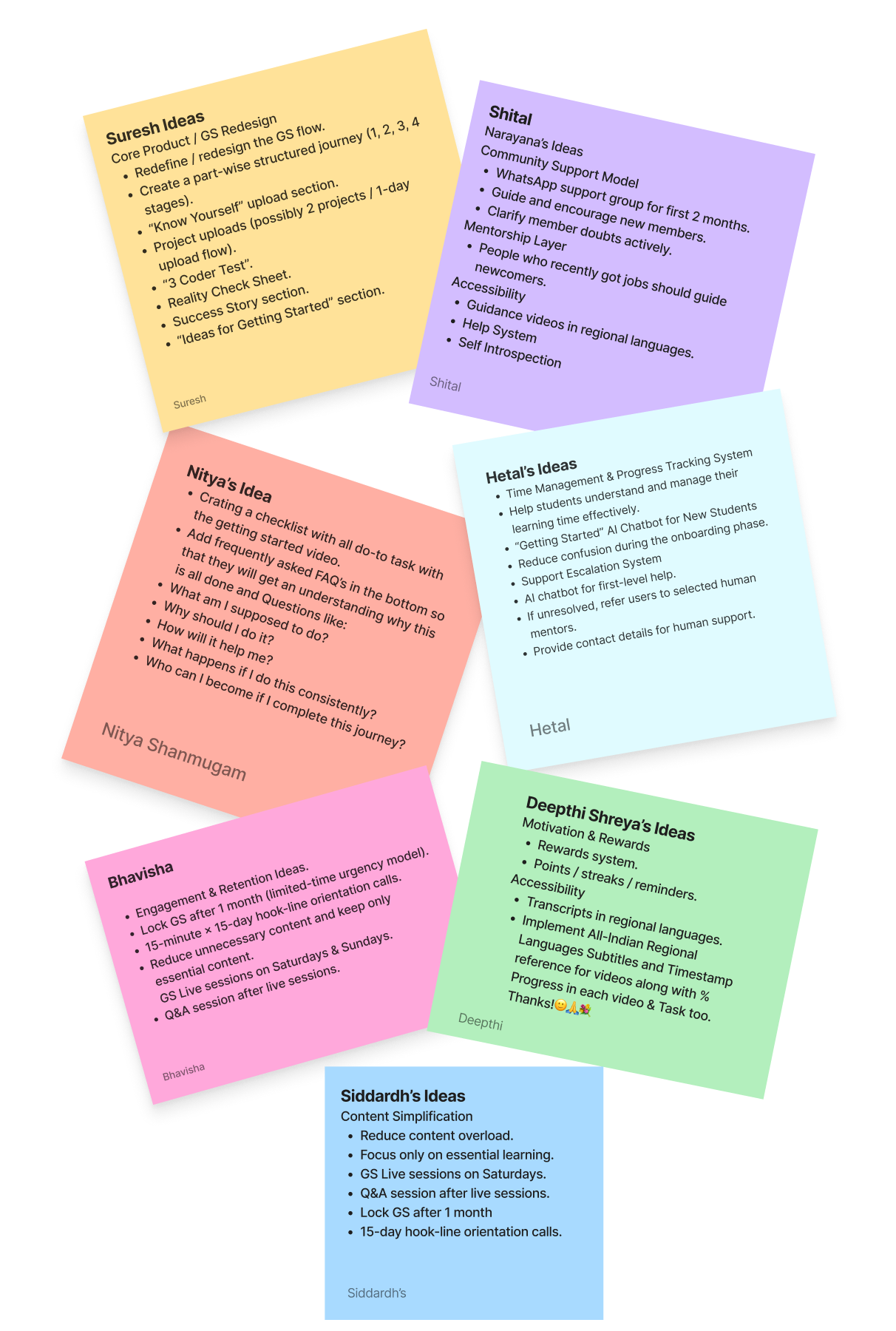
Collaborative ideation across the team of 8 — raw contributions from Suresh, Shital, Nitya, Hetal, Deepthi, Siddardh and myself, synthesised into the four opportunity areas below.
01
Reduce Cognitive Load
Progressive disclosure
Problem
Onboarding surfaced everything at once.
Opportunity
Sequence the journey into small, single-focus actions.
02
Create Small Wins Early
Small wins
Problem
Learners left before experiencing success.
Opportunity
Place a completable action inside the first session.
03
Increase Progress Visibility
Visible progress
Problem
Effort was invisible, so progress felt like nothing.
Opportunity
Make momentum legible at every stage.
04
Design Recovery Systems
Recovery loops
Problem
A missed day turned into a permanent exit.
Opportunity
Give learners an explicit, guilt-free way back in.
07 · Solution
Decoded DFC Retention & Engagement System
01
Discover Your Path
Create clarity and confidence.
02
Know Yourself
Increase self-awareness and learning direction.
03
Build Momentum
Create consistency through small actions.
04
Reality Reset
Encourage reflection and long-term commitment.
Behavioral design principles
Principle
UX mechanism
Intended behavior
Progressive Disclosure
Stage-based journey that reveals depth only after the current step
Learners start without scanning the whole catalogue
Small Wins
One completable action per step, sized for a short evening
Early success before the first drop-off window
Visible Progress
Stage progression and a 14-day momentum tracker
Effort feels cumulative rather than lost
Recovery Loops
Missed days absorbed by the 14-day runway and re-entry prompts
Returning feels normal, not like restarting
Community Belonging
Community conversations tied to journey stages
Continuation is socially reinforced, not solitary
Design artifacts
Onboarding flow
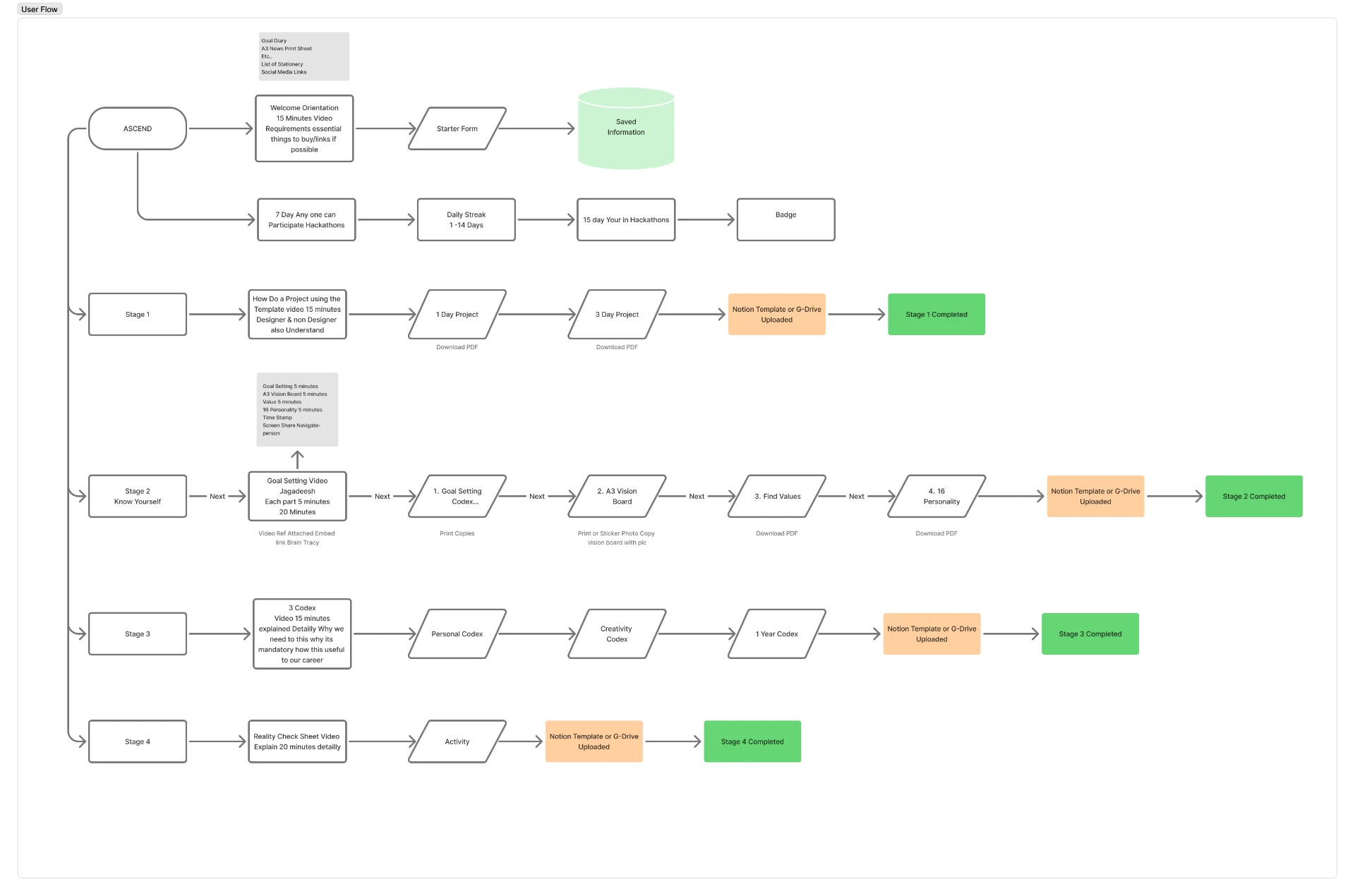
The stage-based onboarding and streak flow — welcome orientation, the 1–14 day momentum track, and four sequential stages that each close on a visible completion state. Open full size.
Information architecture
Conceptual framework
Why it mattered
Content depth was visible before it was relevant.
What changed
Depth is nested behind stages and revealed progressively.
Learner journey
Conceptual framework
Why it mattered
Drop-off had to be located, not guessed.
What changed
Journey mapped against real availability, exposing the day 3–4 break.
Recovery pathway
Conceptual framework
Why it mattered
Missed days produced backlog anxiety with no route back.
What changed
A defined re-entry path absorbs missed days inside the 14-day runway.
Progress tracker
Conceptual framework
Why it mattered
Learners could not see that they were moving.
What changed
Stage and day-level progress made momentum visible.
Behavioral system
Conceptual framework
Why it mattered
Individual screens could not carry retention on their own.
What changed
Principles, mechanisms and metrics connected into one system.
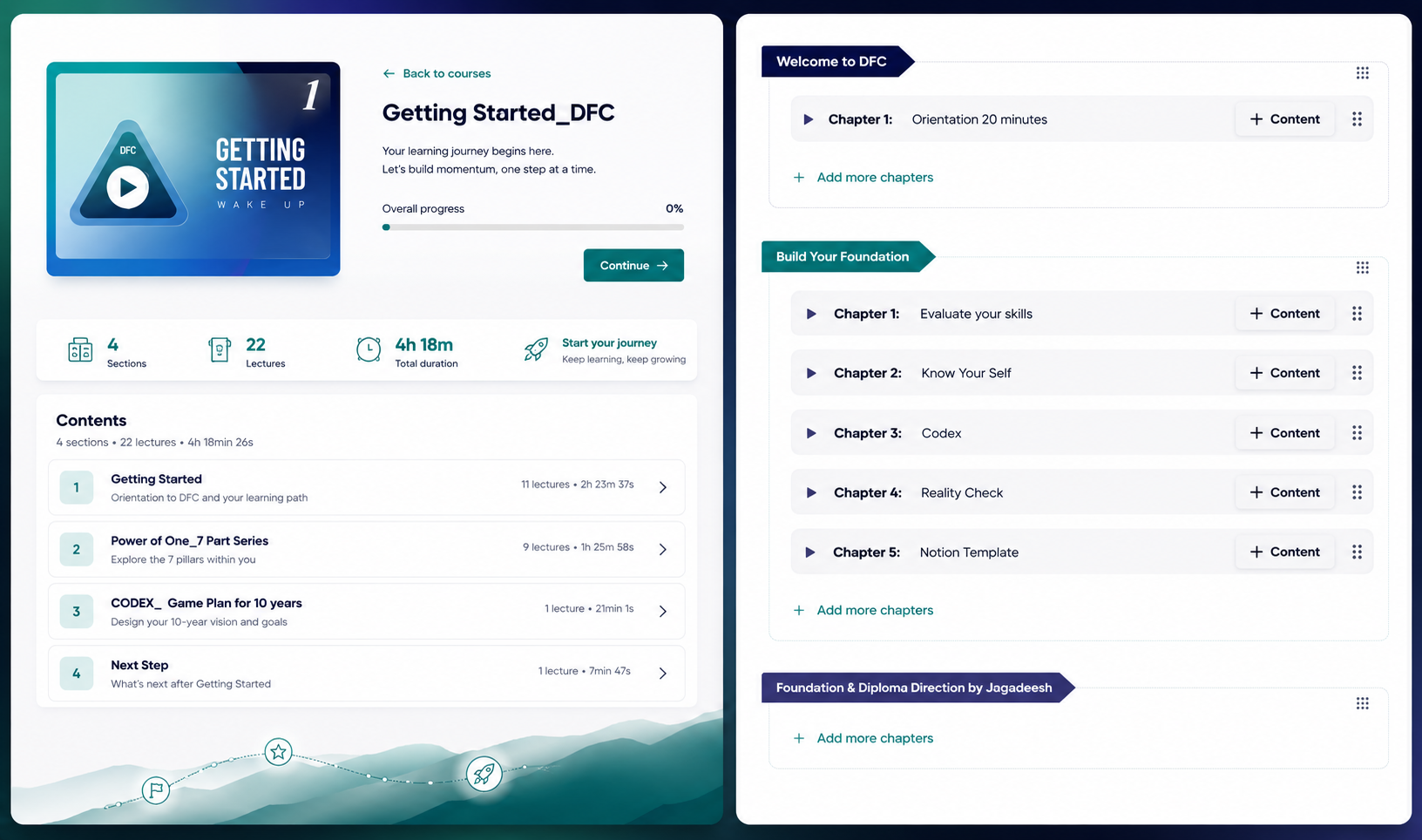
Redesigned learner journey and structured chapter system
Content that once arrived as one long list now unfolds as staged sections with visible progress — the shift from fragmented content to structured momentum.
Before
Long onboarding
Multiple content requirements
High cognitive load
No clear recovery path
Weak progress visibility
After
Stage-based journey
Smaller actions
Progressive disclosure
Recovery pathways
Visible momentum
Fragmented journey → structured momentum
08 · Testing
What I tested and learned
Concepts were tested to validate whether learners could understand the new journey and complete smaller actions with less cognitive friction.
Hypothesis
If the journey is staged, learners will understand where to begin without guidance.
What we tested
Walkthroughs of the stage-based path against the original catalogue entry.
What we learned
Learners identified their next action immediately once only one step was visible.
What changed
Progressive disclosure was kept as the default, not an option.
Hypothesis
If actions are smaller, learners will complete one without feeling behind.
What we tested
Concept sessions on single-action steps sized for a short evening.
What we learned
Reduced step size removed the hesitation that preceded drop-off.
What changed
Every stage was rewritten around one completable action.
Hypothesis
If the runway is longer, a missed day will not end participation.
What we tested
Pacing concepts at 7 days versus 14 days against research themes.
What we learned
Sustainable rhythm mattered more than artificial speed.
What changed
The momentum challenge moved from 7 days to 14.
09 · Impact
What changed
+32%
Completion rate improvement
4 stages
Structured learning journey
14-day
Momentum framework
50.7%
Recoverable user opportunity
1 in 3
Reactivation potential
4h 18m1h 15mOnboarding optimization
Primary outcome metric
Increase the percentage of learners completing at least one meaningful DFC learning activity on 7 of their first 14 days.
Supporting behavioral metrics
Onboarding completion rate
Weekly active learners
Task completion rate
Re-engagement rate
Recovery conversion rate
Community participation
Proof submission rate
10 · Reflection
What this project taught me
Retention is rarely a motivation problem.
Most learners already want to succeed.
The real challenge is helping them continue when life becomes busy, stressful, or unpredictable.
By reducing friction, creating visible progress, and designing recovery mechanisms, we can help learners build sustainable momentum instead of relying on motivation alone.
“Great onboarding is not about delivering more content. It is about helping people feel capable, supported, and successful from their very first interaction.”